
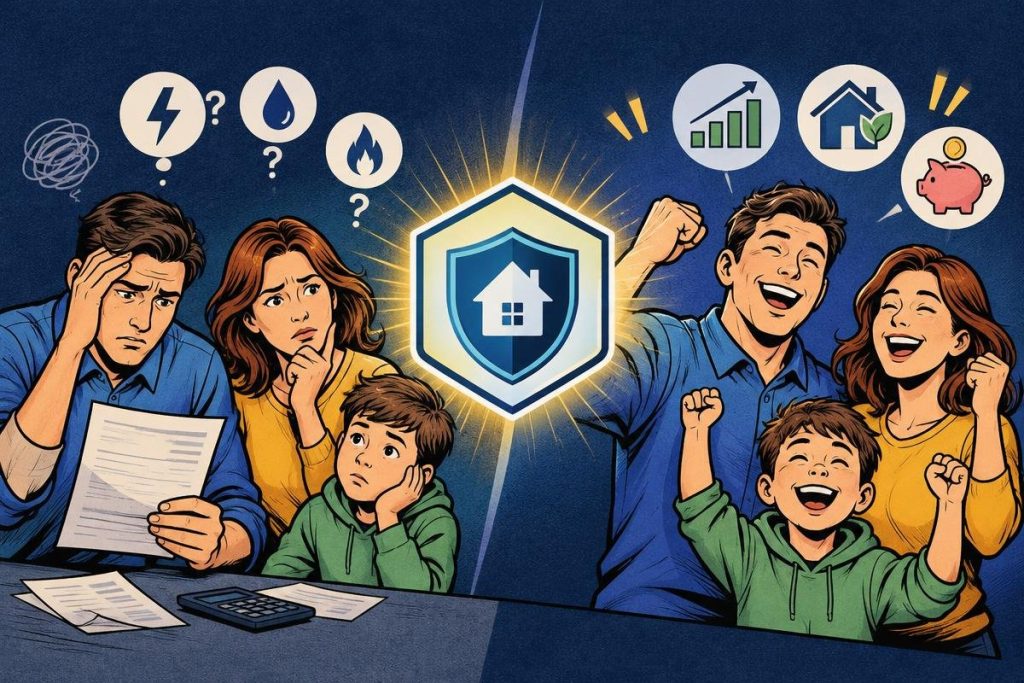
At the beginning of every month, a family’s energy story can feel like a mystery. The electricity bill arrives, the heating has been running more often, someone has left a light on upstairs, and nobody is quite sure whether the smart meter is helping or simply adding another number to watch. Then there are water bills, broadband, mobile services, waste collection, tariffs, repairs, and the small but important question of who has access to which account. The good news is that a little structure can turn this confusion into a useful household system. This guide follows a fictional family before and after they organised their energy and utilities, offering practical tips and a resource list that families can use to make everyday decisions clearer, safer, and more affordable.
1. Begin with the “before” picture
Meet the Martins: two parents, two children, a dog, and a home that seems to use energy in every possible way. Their mornings begin with a kettle, a shower, a washing machine, lights, laptops, and a race to get out of the door. Their evenings include cooking, television, homework, gaming, laundry, and sometimes an electric heater in the coldest room.
For years, the Martins managed utilities reactively. They opened bills when payment reminders arrived. They searched for account passwords only when something went wrong. They compared tariffs when prices had already changed. They reported leaks, meter issues, and service interruptions individually, without keeping a record of previous conversations.
The result was not one dramatic mistake. It was a collection of small problems:
• Bills were difficult to understand. Estimated readings made some months look unusually cheap and others unexpectedly expensive.
• Nobody had a complete account list. One parent managed electricity, the other handled broadband, and the children knew the Wi-Fi password but not where it came from.
• Energy-saving efforts were inconsistent. The family bought efficient bulbs but left appliances on standby. They lowered the thermostat occasionally but did not understand how heating schedules affected comfort and cost.
• Important correspondence was scattered. Emails, letters, screenshots, and reference numbers lived in different places.
• Household access was informal. A family member might forward a password or leave an account open on a shared device, creating avoidable privacy and security risks.
The first lesson is simple: you cannot improve what you cannot see. Before changing suppliers, buying equipment, or cutting usage, create a reliable snapshot of the household’s current position.
2. Make a family utilities inventory
Think of a utilities inventory as a household map. It should show what services the family uses, who provides them, how they are paid for, and where the relevant information is stored.
Start with the obvious services:
• Electricity
• Gas or other heating fuel
• Water and wastewater
• Broadband and home phone
• Mobile phone services
• Waste and recycling collection
• Home energy equipment, such as solar panels, batteries, heat pumps, or electric vehicle chargers
• Home security, monitoring, or connected-device subscriptions
For each service, record the provider, customer service contact, account number, renewal or review date, payment method, and the name of the account holder. Do not place sensitive passwords in an ordinary spreadsheet or a document shared widely with the family. Instead, use a reputable password manager and record only a secure reference to where the login is stored.
The “before” version of the Martins’ inventory was a pile of envelopes and a few browser bookmarks. The “after” version became a one-page household dashboard with links to the relevant secure accounts. They also created a short emergency sheet containing service names, emergency contact numbers, meter locations, and the location of the stopcock, fuse box, and main gas shutoff where applicable.
A clear inventory helps in several ways. It prevents duplicate services, makes moving home easier, supports budgeting, and reduces the stress of dealing with an outage. It also helps families identify accounts that may contain sensitive information. In situations involving disputes, professional advice, or regulatory questions, maintaining organised records can also support legal privilege protection by helping the family distinguish routine service records from confidential communications with qualified advisers. Legal privilege rules vary by jurisdiction, so families should seek appropriate legal guidance rather than assume every document is protected.
3. Turn bills into useful information
A utility bill is more than a request for payment. It is a record of usage, pricing, taxes, credits, meter readings, and contract terms. Families do not need to become energy economists, but they should learn to locate a few important details.
When reviewing an electricity or gas bill, look for:
• The billing period. Check whether the bill covers a normal month, a longer period, or a correction.
• Actual or estimated readings. An estimated reading may not reflect what the household really used.
• Units consumed. The amount of energy used is different from the total price paid.
• Unit rates and standing charges. Both can affect the final bill, even when consumption stays the same.
• Taxes, fees, discounts, and credits. These may explain changes that are not caused by household behaviour.
• Contract terms. Check the end date, exit fees, automatic renewal conditions, and any variable pricing.
The Martins used to compare only the total amount due. After building a simple monthly tracker, they began comparing consumption and price separately. This revealed that a higher winter bill was partly caused by increased heating use and partly by a change in the unit rate. Those are different problems and require different responses.
Families can create a basic table with the following columns:
Month | Energy used | Total bill | Average temperature or season | Main changes in the home | Meter reading type
This does not need to be perfect. The purpose is to notice patterns. A family may discover that laundry is concentrated on expensive periods, that an old freezer uses more energy than expected, or that a heating schedule is running while everyone is away.
4. Build a realistic household energy baseline
Before-and-after comparisons are meaningful only when there is a baseline. A baseline is a reasonable description of normal household use before making a change.
Choose a period of at least one month, and ideally compare several months across different seasons. Record the main factors that influence consumption:
• Number of people at home
• Heating type and temperature settings
• Time spent at home
• Cooking habits
• Laundry frequency
• Use of entertainment and gaming equipment
• Electric vehicle charging
• New appliances or home improvements
• Weather conditions
The Martins discovered that their highest-use days were not always the coldest ones. A weekend of baking, washing clothes, hosting relatives, and charging devices could produce more electricity use than a quiet weekday. That insight helped them focus on routines rather than blame.
It is important to avoid promising a fixed level of savings. Household energy use depends on building condition, climate, equipment, occupancy, prices, and personal needs. A family with medical equipment or mobility requirements may not be able to reduce usage in the same way as another household. The goal is informed control, not a competition to use the least energy.
5. Walk through the home as an energy detective
One Saturday morning, the Martins treated their home like a detective scene. They moved room by room, asking three questions: What uses energy here? What controls it? What evidence would show that it is working efficiently?
In the kitchen, they checked the refrigerator temperature, inspected door seals, and looked at how often the oven and kettle were used. In the utility area, they checked whether the washing machine and dryer had efficient settings. In the living room, they noticed that a television, games console, speakers, and chargers remained powered even when nobody was using them.
In bedrooms, they looked at lighting and electronic devices. In the hallway, they checked whether lights were being left on unnecessarily. In the bathroom, they reviewed hot-water use and looked for dripping taps. Outside, they inspected whether outdoor lighting was controlled by a timer or left on continuously.
Use care around electrical equipment, gas appliances, wiring, and heating systems. Do not remove covers, alter connections, or attempt repairs unless you are properly qualified. For safety-critical work, use an authorised professional and follow local rules.
The family’s “after” list contained several low-cost changes:
• Replace frequently used bulbs with suitable efficient alternatives.
• Use timers or smart controls where they genuinely simplify routines.
• Turn off devices that do not need to remain active.
• Wash clothes at appropriate temperatures and full loads where practical.
• Use heating schedules that reflect occupancy.
• Keep vents, radiators, and heat-pump airflow areas clear.
• Check for dripping taps and report leaks promptly.
The most effective changes were not necessarily the most expensive. They were the ones the family could repeat without constant effort.
6. Improve heating without sacrificing comfort
Heating often dominates household energy use, particularly during colder months. Families may assume that the only options are turning the thermostat down dramatically or replacing the entire heating system. In reality, improvement can happen in stages.
Begin by understanding the controls. Identify the thermostat, programmer, radiator valves, boiler or heat-pump settings, and hot-water controls. If the household is unsure how the system works, consult the manufacturer’s instructions or ask a qualified technician to explain it.
Then consider the building itself. Draughts around doors and windows, poor insulation, blocked vents, and damp can all affect comfort and energy use. Some improvements may be eligible for local grants or assistance, while others require professional assessment. Check official government, local authority, or energy-agency resources before paying a company that promises guaranteed savings.
The Martins changed their heating routine gradually. They programmed the system to warm the home around school and work schedules, reduced unnecessary heating in unused rooms, and kept doors closed where appropriate. They also created a winter checklist to identify draughts and unusual cold spots.
After the changes, the home did not feel “cold because the family was saving money.” It felt more consistent because the heating was being controlled deliberately. That distinction matters. A sustainable household plan must support health, comfort, and safety.
7. Use smart meters and apps thoughtfully
Smart meters, in-home displays, and supplier apps can help families understand energy use in near real time. They can also create noise. A child may boil the kettle and worry about the number changing, while a parent may spend more time watching the display than acting on the information.
Use smart data to answer practical questions:
• What is the home’s typical background use?
• Which appliances create a noticeable change?
• What happens when heating starts?
• Does usage fall when the family leaves for school and work?
• Are readings consistent with the bill?
Choose one or two experiments. For example, record the household’s usual evening consumption, then compare it with an evening when unnecessary devices are switched off. Another experiment might compare a planned laundry day with several small loads. Keep expectations realistic: a single experiment will not explain every bill.
Protect the account behind the app. Use unique passwords, multi-factor authentication where available, and separate household profiles if the service supports them. Avoid sending screenshots that reveal account numbers, addresses, or detailed consumption patterns in public forums.
8. Create a family account and privacy routine
Utilities are increasingly digital. That makes access convenient, but it also means families need a clear rule for sharing information.
Agree who can:
• View bills and usage.
• Make changes to a tariff or contract.
• Contact a provider.
• Authorise repairs or appointments.
• Access smart-home controls.
Children can learn useful habits without receiving unrestricted access to sensitive accounts. For example, they can help read a meter, switch off devices, or track a weekly energy goal while an adult handles payments and account changes.
Never share one password across every service. A password manager can generate and store unique credentials. Keep recovery email addresses and phone numbers current, and review connected devices from time to time. When a family member moves out, a housemate leaves, or a contractor no longer needs access, remove that access promptly.
For documents involving complaints, contracts, disputes, or professional advice, save original messages and dates. Keep factual service records separate from personal notes and confidential legal communications. Again, legal privilege protection is fact-specific and jurisdiction-dependent; preserving records is helpful, but it does not automatically make a document privileged.
9. Prepare for outages, leaks, and emergencies
The best time to prepare for a power cut or water leak is before it happens. The Martins created an emergency card and placed copies in a kitchen drawer and a secure digital folder.
Their resource list included:
• Electricity emergency number
• Gas emergency number, where relevant
• Water emergency or leak-reporting contact
• Broadband provider support details
• Local emergency services number
• Property manager, landlord, or building manager contact
• Location of the fuse box, meter, stopcock, and main shutoff controls
• Instructions for essential medical equipment
• Details of vulnerable household members or neighbours who may need assistance
Keep torches, batteries, power banks, and basic supplies where everyone can find them. Do not use candles near children, pets, curtains, or other flammable materials. Never use a barbecue, generator, camping stove, or fuel-burning appliance indoors because of the risk of carbon monoxide and fire.
If the household includes someone who depends on electrically powered medical equipment, contact the relevant provider and healthcare professional about emergency planning. Do not rely solely on a general priority register; confirm exactly what support is available and what backup arrangements are needed.
10. Compare suppliers and tariffs carefully
Switching providers can sometimes help, but the cheapest headline price is not always the best fit. Before changing, compare the full terms:
• Fixed and variable rates
• Standing charges or daily fees
• Contract duration
• Exit fees
• Payment requirements
• Renewable-energy claims and what they mean
• Customer service channels
• Smart-meter or equipment requirements
• Support for customers experiencing payment difficulty
Use official comparison services or reputable independent tools where available. Be cautious of unsolicited calls, pressure sales, requests for immediate payment, or anyone asking for passwords or one-time security codes. Verify a company through contact details found independently rather than using a link in an unexpected message.
The Martins learned that a tariff decision should fit their household pattern. A plan with a lower rate at certain times might be useful if they could shift some laundry or vehicle charging. It would be less useful if the family could not change its routine. A tariff is a tool, not a personality test.
11. Support families facing high bills
Energy affordability is not just a budgeting issue. A sudden bill can affect food, rent, medication, transport, and mental wellbeing. Families should seek help early rather than waiting until a payment problem becomes a crisis.
Useful resources may include:
• The energy supplier’s affordability or hardship team
• Local government or council support
• Consumer-protection agencies
• Independent energy advice organisations
• Benefits and welfare advisers
• Housing associations or tenant-support services
• Charities supporting older people, disabled people, or families with children
Ask what assistance is available before agreeing to a payment arrangement. Keep records of calls, names, dates, reference numbers, and promised follow-up. If a bill appears wrong, ask for a written explanation and make a formal complaint through the provider’s process. Escalation options differ by country, so consult the relevant official regulator or ombudsman.
The “after” version of the Martins’ plan included a monthly money check-in. It was not a meeting about blame. They reviewed upcoming bills, expected seasonal changes, and any support they might need. This made difficult conversations less frightening because they happened before the account was in crisis.
12. Build a resource shelf for the whole family
A good household resource list should be short enough to use and broad enough to cover common needs. Bookmark official sources for your country or region, including:
• Your energy regulator or public utilities commission for consumer rights, complaints, and market information.
• Your local government or council for recycling, water, emergency planning, grants, and household assistance.
• Your energy supplier’s official account and emergency pages for bills, outages, payment support, and meter guidance.
• A trusted energy-efficiency agency for insulation, heating, appliances, and home-energy advice.
• Your water provider for leaks, billing, drought information, and water-saving guidance.
• Your consumer-protection authority for scam alerts, contract rights, and complaint procedures.
• Your network operator for outage updates and safety information.
• A qualified local professional for electrical, gas, heating, insulation, or renewable-energy work.
• A reputable password manager for secure household account access.
• A secure family document system for bills, warranties, service records, and emergency information.
Review the list twice a year. Websites, phone numbers, tariffs, eligibility rules, and household needs change. Add a date beside each resource so the family knows when it was last checked.
13. Run a simple before-and-after review
After three months, the Martins compared their new system with their old one. They did not judge success only by the size of the bill because energy prices and weather had changed. Instead, they asked broader questions:
• Do we understand our bills better?
• Can we find every provider and account quickly?
• Are meter readings more accurate?
• Have we reduced waste without reducing essential comfort?
• Do we know what to do during an outage or leak?
• Can both adults manage important accounts?
• Are children learning safe and practical energy habits?
• Are our passwords, devices, and documents protected?
• Do we know where to seek help if bills become unaffordable?
Their after-picture was not a perfect home with zero energy use. It was a calmer home with fewer surprises. They knew which changes mattered, which questions to ask, and where to find reliable information. That is a valuable result for any family.
Conclusion
Managing household energy and utilities does not have to begin with a major renovation or a complicated spreadsheet. Start with the before picture: list the services, understand the bills, observe routines, protect account access, and prepare for emergencies. Then make a few practical changes, measure what you can, and review the results together. The most useful resource is often not a single gadget or tariff but a shared family system that turns scattered information into confident action. Learn more at thinkpigeon.com, or activate your new ID to help your household keep important access and information organised.