
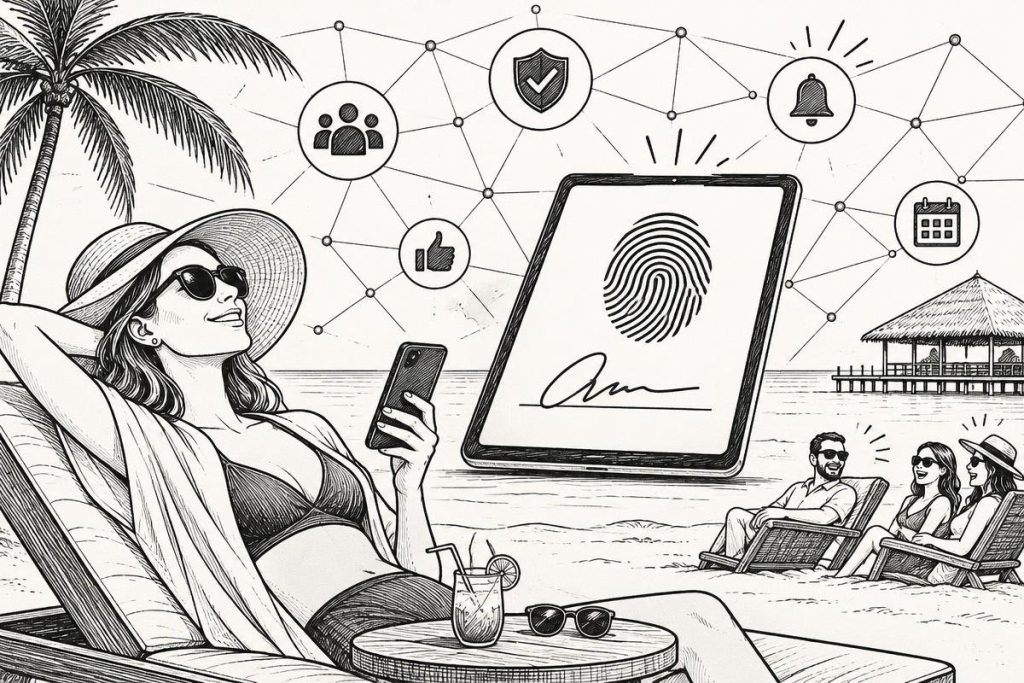
For organisations serving high-net-worth individuals, the modern beach experience is no longer defined only by privacy, location, or service. It is increasingly shaped by how securely and effortlessly guests access information, reservations, member benefits, and personalised support. From private island resorts to luxury coastal developments and invitation-only beach clubs, organisations face a difficult challenge: delivering frictionless digital access without compromising identity protection. Traditional registration processes, repeated passwords, and data-heavy sign-up forms can create unnecessary barriers for clients who expect discretion and efficiency. A new approach—built around portable digital identity and no email sign-up—offers a practical route forward. By simplifying access while reducing exposure to sensitive personal information, organisations can create a more trusted and sophisticated relationship with their most valuable guests.
The challenge facing luxury beach organisations
High-net-worth individuals increasingly move between multiple properties, clubs, advisers, travel providers, and hospitality services. Each organisation may ask them to create another account, verify another email address, or submit the same personal information through another online form. Although these processes are familiar, they are not necessarily appropriate for a clientele that places a high value on privacy, time, and control.
For beach resorts and private coastal organisations, the problem is particularly visible. A guest may need access to a digital concierge, a beach-club booking system, a private event invitation, or a secure members’ portal. If each service requires a separate login, the guest experience becomes fragmented. If staff manage access manually, operational costs increase and the likelihood of errors grows. If the organisation stores more data than it needs, its exposure to security and compliance risks also expands.
This creates a strategic tension. Organisations want to know that the person accessing a service is authorised, while guests do not want to repeatedly disclose personal details simply to enjoy a benefit to which they are entitled. The challenge is therefore not only technological. It is also relational: how can an organisation demonstrate respect for a client’s identity while maintaining reliable access control?
Why digital identity matters in high-value environments
Digital identity is often discussed as a technical function, but in premium environments it should be understood as part of the service proposition. A well-designed identity system can help an organisation establish who has access to a service, what that person is entitled to use, and how access can be managed over time. Crucially, it can do this without requiring the organisation to collect every possible piece of personal information.
For high-net-worth individuals, this distinction matters. Privacy is not simply the absence of publicity; it is the ability to decide when, where, and how personal information is shared. A guest may be willing to prove eligibility for a private beach club, for example, without wanting the club to retain extensive details about their family, travel schedule, or wider financial circumstances.
Organisations can respond by adopting a principle of data minimisation. Instead of treating registration as an opportunity to gather information, they can ask a more disciplined question: what is the minimum information required to provide this service securely? Identity solutions that support controlled, user-managed access can help make this principle operational.
The case for a no-email sign-up experience
Email remains useful, but it is not always the best foundation for a premium digital relationship. Email addresses are frequently shared, recycled, exposed in data breaches, or used across numerous services. They can also turn a simple access request into a lengthy process involving verification links, password creation, and account recovery.
A no email sign-up approach can reduce this friction. Rather than beginning with an email form, an organisation can invite a guest to activate or use a secure digital identity. This shifts the emphasis away from creating yet another account and towards establishing trusted, permission-based access.
For guests, the benefits are immediate. They can avoid managing another password and reduce the amount of information they submit during onboarding. For organisations, the benefits include a cleaner registration journey, fewer abandoned sign-ups, and potentially less personal data stored in internal systems. The approach is especially relevant to beach organisations where access may be seasonal, invitation-only, or linked to a specific property, event, or membership tier.
This does not mean that every organisation should eliminate email from its entire operating model. Rather, it means email should not be treated as the only doorway to identity. A more flexible architecture can give guests a choice while enabling the organisation to apply consistent access rules.
From digital friction to competitive advantage
In a competitive luxury market, small moments of friction can influence whether a guest returns, recommends a property, or chooses a competing service. A complicated sign-up process may appear insignificant to an internal team, but it can feel disproportionate to a client who expects immediate, discreet assistance.
Consider the arrival experience at a private beach resort. A guest receives access to a digital welcome service before travelling. They can view private dining options, reserve a cabana, request transport, and confirm preferences through a secure identity. On arrival, the same identity supports access to relevant services without requiring the guest to repeat information. If permissions change—for example, when a stay ends or a membership is suspended—the organisation can update access without relying on informal communication.
The value of this model is not limited to convenience. It can create a more coherent relationship between the organisation and its guest. Staff gain a clearer understanding of authorised services, while guests gain greater visibility into how their identity is used. In this sense, secure digital identity becomes part of hospitality: invisible when functioning well, but influential in shaping trust.
Designing an identity strategy for beach services
Organisations considering a new identity model should begin with the guest journey rather than with a particular software feature. Mapping each stage—from invitation and onboarding to booking, access, support, and departure—can reveal where unnecessary information requests or duplicated authentication steps occur.
The next step is to define access categories. A beach club may need different permissions for permanent members, short-term guests, family members, staff, event attendees, and external service providers. These categories should be expressed as clear rules, allowing access to be granted or withdrawn in a controlled manner.
Governance is equally important. Organisations should establish who is responsible for identity verification, how consent is recorded, how access is audited, and what happens when a guest loses control of a device or identity credential. The most elegant user experience still requires robust operational procedures behind the scenes.
Finally, organisations should measure success using both security and service indicators. Useful measures may include onboarding completion rates, support requests, time taken to grant access, the volume of stored personal data, and guest satisfaction. This balanced assessment prevents identity projects from becoming purely technical exercises and keeps attention on the business outcomes that matter.
Preparing for a more private digital future
The direction of travel is clear: premium organisations are being asked to deliver more personalised services while collecting and exposing less information. This is not a contradiction. When identity is designed around user control, verifiable permissions, and limited disclosure, personalisation can become more respectful rather than more intrusive.
For beach resorts, private clubs, coastal developments, and the organisations that support them, this shift represents an opportunity to lead. A secure identity system can improve the guest experience, simplify administration, and strengthen the organisation’s privacy posture at the same time. It can also signal that the organisation understands the expectations of high-net-worth individuals: access should be effortless, information should be handled carefully, and trust should not be treated as an afterthought.
The organisations most likely to benefit will be those that approach identity as a strategic service decision. They will test the experience from the guest’s perspective, reduce unnecessary data collection, and create access journeys that are as refined as the physical environments they represent.
In the evolving luxury beach sector, privacy and convenience are no longer competing priorities. With the right digital identity model, they can reinforce one another—helping organisations provide secure, elegant, and memorable experiences for the people they serve. Learn more: https://thinkpigeon.com or Activate your new ID.